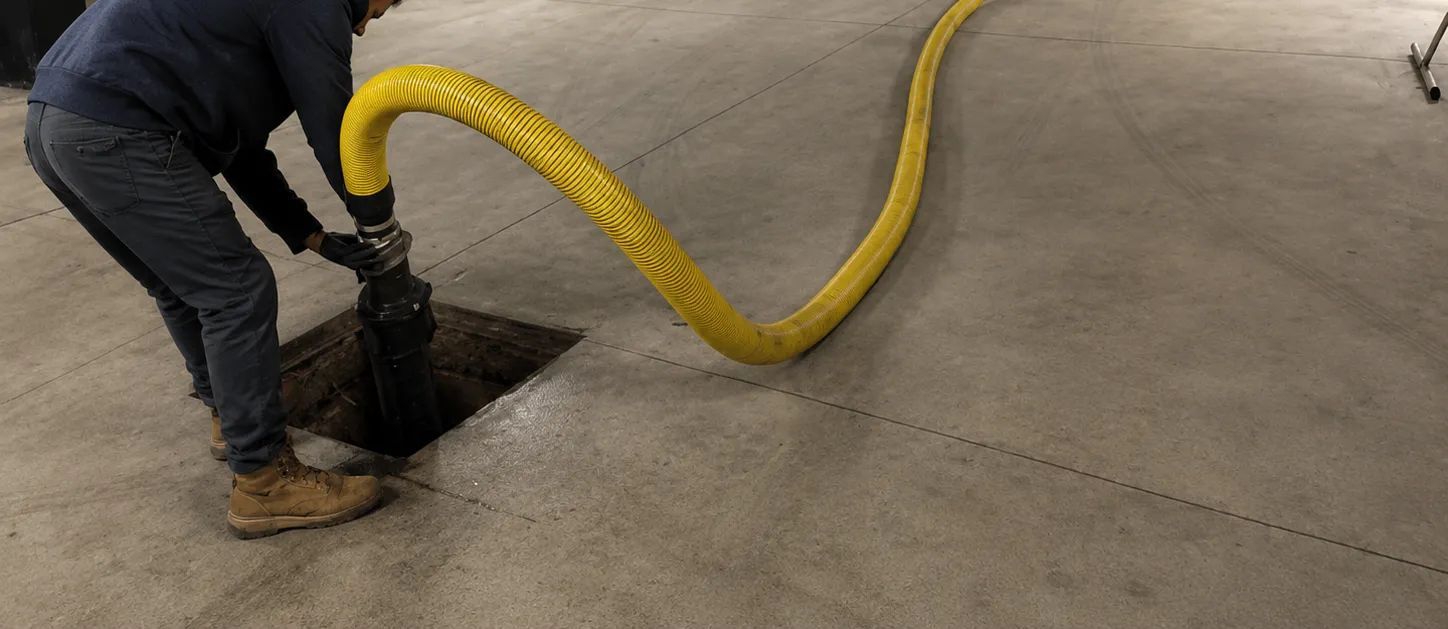
Why Snaking Keeps Failing Your Commercial Drain Line in Louisville, KY (and What Jetting Fixes)
QUICK ANSWER: A snake clears the blockage in front of the cable, but it leaves most of the grease, scale, and root debris coating the pipe wall, which is why the same line backs up again a few weeks or months later. Drain line jetting sends pressurized water through the whole line and scours the walls back toward full diameter. Jetting is the better choice for recurring backups, grease lines, root intrusion, and main sewer runs. Snaking still has a place for a single soft blockage in a sound line. A camera look before the work settles which one your pipe actually needs.
The floor drain in the prep area was fine last week. This morning it is gurgling, and a shallow skin of gray water sits around the grate while the dish machine runs. The plumber who came out the last time ran a cable, pulled back a ball of grease and paper, and the drain ran clean for about a month. Now you are looking at it again, and you are starting to suspect the cable never fixed anything.
You are probably right. Commercial lines in restaurants, car washes, fleet shops, and industrial buildings do not clog the way a household sink does. They narrow. Grease cools and sticks, sediment settles into it, roots find a joint, and the pipe slowly loses diameter until a small obstruction finishes the job. Treating the last inch of that problem with a cable is why the problem keeps coming back.
This article explains what a snake actually does, what builds up inside a commercial line, how drain line jetting works, and how to decide between the two for lines in Crestwood, Louisville, and across Southern Indiana.
What a Snake Actually Does Inside a Pipe
A drain snake, also called an auger or cable machine, pushes a rotating cable with a cutting or hooking head into the line until it meets resistance. The head bores into the obstruction, hooks it, or breaks it apart so water can pass. On a soft clog in a clean pipe, that is often all you need.
The limit is the size of the opening. In a pipe that is already coated, the cable usually opens a channel only a couple of inches wide through the middle of the blockage. Water drains again, so the job looks successful. But the grease, scale, and sludge stuck to the walls on either side of that channel are still there. A snake can pass straight through a grease blockage without removing the film that lines the pipe.
That leftover layer is the reason repeat visits follow a pattern. The first backup clears. The channel slowly narrows as new grease and solids attach to the old layer. A few weeks or months later, the line backs up again, and the cycle repeats. You are paying to clear the symptom while the cause stays in place.
What Builds Up on the Inside of a Commercial Drain Line
Knowing what is coating the pipe tells you which tool belongs on the job.
Grease
Fats and oils harden along pipe walls, trapping food solids and restricting commercial kitchen drainage.
Scale And Sediment
Mineral scale, grit, and settled solids create rough pipe surfaces that accelerate further buildup and blockages.
Roots
Roots enter through cracks and loose joints, spreading inside pipes and trapping grease, solids, and debris.
Debris
Leaves, silt, and trash collect in exterior drains, restricting water flow during heavy rainfall.
Multiple Buildup Types
Commercial drain lines often contain several buildup types simultaneously, making thorough cleaning more effective than narrow clearing.
How Drain Line Jetting Works
Drain line jetting, often called hydro jetting, uses a hose fed into the line with a specialized nozzle on the end. Water leaves the nozzle through small jets under high pressure. The jets scour the interior of the pipe as the nozzle travels, and the operator moves the hose back and forth through the run until the walls are clean and the debris has been flushed out.
Two things separate it from snaking. First, it works on the whole inside surface of the pipe instead of a single path through the middle. Grease, scale, and sediment are stripped from the walls, not just pushed aside. Second, it uses water and pressure instead of blades. No cutting head scrapes along the pipe, so the method relies on controlled pressure alone.
Pressure is not one fixed number. Jetting equipment works across a wide range, commonly in the low thousands of pounds per square inch, and the operator matches the setting to the pipe material, its condition, and the type of buildup. A hardened grease line and a fragile older drain should not get the same treatment. Matching pressure to the pipe is the part of the job that takes experience.
The result is a line that has had its working diameter restored. Water moves through at full capacity again, and the smoother walls give new grease and debris less to hold onto, so the line tends to stay clear for longer after the work than it does after a cable.
Snaking Versus Jetting: Where Each One Makes Sense
Neither tool is wrong in every case. The right choice depends on what the blockage is made of and how often it returns.
A Single Soft Blockage In A Sound Line
A drain snake clears soft paper or debris blockages in otherwise clean pipes without requiring extensive cleaning.
Recurring Backups At The Same Drain
Hydro jetting removes buildup coating pipe walls, helping prevent recurring blockages that return after temporary clearing.
Heavy Grease
High-pressure water breaks down hardened grease and flushes residue away, cleaning pipe walls more thoroughly than snaking.
Roots
Hydro jetting clears loose root material and scours pipe walls, but root entry points still require separate repairs.
Main Sewer Lines
Hydro jetting removes accumulated grease, solids, and debris throughout main sewer lines, restoring flow across the entire run.
Storm Drains Packed With Silt And Leaves
Water flushing removes accumulated silt and leaves from storm drains, clearing pathways for effective runoff drainage.
TIP: When a drain keeps failing, ask for a camera inspection of the line before choosing a method. The picture shows whether you are dealing with grease on the walls, roots at a joint, or a damaged section, and that decides whether you need a cable, a jetting pass, or a repair.
Roots: Why the Clog Comes Back
Roots deserve their own look because they are the most misunderstood part of the snake versus jetting question. Research on sewer stoppages has attributed more than half of them to roots, which makes sense given what roots are after. A sewer line is a steady source of water, nutrients, and oxygen, and roots grow toward all three.
Roots do not need a large opening. They get in through small cracks and joints that no longer hold tight, then expand once inside. Fine roots feed on the flow, and over time they thicken and form a screen that catches grease, paper, and solids. The line narrows from a trickle of roots to a solid mat.
Cutting roots solves the immediate problem and does very little else. Studies of root control have noted that cut roots often grow back, sometimes with more vigor than before. A cable that bores through a root mass leaves cut stubs in the pipe wall, and those stubs recover.
Jetting handles roots better than a cable because it clears loose root material and scours the pipe surface afterward. It does not close the crack or joint where the roots came in. That is why a root problem is best handled with a plan: clear the line, inspect it, and put the line on a preventive jetting schedule so roots are cleared before they build into a mat again. Where the pipe itself has failed, a repair is the permanent fix, and jetting buys the time to plan it.
When Jetting Is Not the Whole Answer
Jetting cleans a pipe. It does not repair one. Cracks, offset joints, sagging sections, and collapsed pipe stay as they are after the line is cleaned, and a camera inspection is the way to see them.
Pipe material and age also matter. Cast iron can corrode and hold heavy scale. Clay lines can crack at the joints. Plastic pipe can be offset, crushed, or poorly supported after years in the ground. On an older or fragile line, an operator may start with a gentler approach, inspect the pipe, and step up from there. That is one reason a good jetting visit starts with a look at the line and not with a full pressure pass.
WARNING: Do not keep sending a cable through a line that backs up again within weeks. Each pass leaves the wall coating in place, and an aggressive cutting head can snag or damage a weak section of pipe. Repeated backups are a signal to inspect the line and clean it properly.
Setting a Jetting Schedule That Matches Your Site
Waiting for a blockage usually means dealing with it at the worst time, in the middle of service or right before a storm. Planned jetting strips buildup before it hardens into a clog, so the line stays open and the surprise calls stop.
How often depends on how fast your lines load up. Commercial kitchens and busy facilities often benefit from jetting every few months on a regular cycle. Lines that carry less grease and solids can go longer between visits. The way to set the interval is to watch what comes out of the line at each visit and adjust. If the first pass pulls heavy grease, the interval is too long. If the line comes out nearly clean, you can stretch it.
Exterior lines follow the weather. Storm drain lines in Louisville and Southern Indiana take in leaves in the fall and heavy rain in the spring, so flushing ahead of those seasons keeps runoff moving. Main sewer runs usually go on a longer cycle, and root prone lines go on a shorter one.
Frequently Asked Questions
What is the difference between drain line jetting and snaking?
Snaking uses a cable to open a channel through a blockage. Jetting uses high pressure water to scour the full inside surface of the pipe. Snaking clears the obstruction in front of the cable, while jetting removes the buildup coating the walls, so lines usually stay clear longer after jetting.
Can jetting clear a line that is completely blocked?
In most situations, yes. The force of the water breaks apart even a stubborn blockage and carries the loosened material out. For severe cases, an inspection first helps the operator choose the right technique and pressure for the line.
Will jetting damage my pipes?
Jetting relies on controlled water pressure and does not use blades. The operator matches pressure to the pipe material and condition. A pipe that is already cracked, offset, or collapsed can still have those defects after cleaning, which is why an inspection is useful on older lines.
Can jetting remove tree roots?
Concentrated water pressure can cut and flush root material and reopen the line. Roots usually return if the crack or joint they entered through is still open, so a preventive schedule or a repair keeps the problem from coming back.
How often should a commercial drain line be jetted?
It varies with usage. Many commercial kitchens and busy facilities benefit from jetting every few months. The best interval comes from looking at how much buildup each visit removes and adjusting from there.
Can crews jet drains outside Crestwood?
Yes. Crews based in Crestwood, Kentucky, regularly serve commercial properties throughout Louisville and into Southern Indiana, including Jeffersonville, New Albany, and Clarksville.
A Clean Pipe Wall Is the Fix That Lasts
The reason a snake keeps failing is simple. It treats the blockage and leaves the buildup behind. A line coated with grease, scale, or roots will narrow again no matter how clean the water runs for a few weeks, and the next backup tends to arrive at the busiest hour, in the middle of service or on the morning of a storm. Clearing the obstruction without clearing the walls is why the same drain comes back onto the schedule month after month.
Jetting addresses the pipe itself. It restores the working diameter, strips away the surface that new grease and debris grab onto, and turns a line you worry about into one you can plan around. Paired with a camera look and an honest read on pipe condition, it tells you what needs cleaning, what needs watching, and what needs repair. With 10
years behind the work, A & K Solutions LLC
jets commercial drain lines
across Crestwood, KY and the surrounding region so your drains stay open when it matters most.